literature synthesis essay – independent learning contract summer 26, the evergreen state college
Introduction
Parasites account for at least half of the world’s organisms. Ranging from microscopic protozoa, viruses and bacteria to macroscopic taxa like nematodes and ticks, the breadth of what species engage in parasitic activity ecologically is immense. For every one host, there are two parasites on average. There is a broad spectrum in-between strictly defined binaries, and for this reason, parasitology is evolving to be a science needing an equally interdisciplinary approach to understanding and synthesis. They remain ubiquitous in the coastal ecosystems around the globe, influencing biodiversity and food webs, where energy is exchanged through an ecosystem.
As they vary from genetics to size, a micro in macro effect is plainly observed as we consider multi-scale dynamics. There has been a lack of understanding for how the multitudinous aspects of interactions play out empirically. Coastal and intertidal ecosystems provide remarkable systems that parasites and hosts interact to varying consequence. From behavioral manipulation to coercion of host resources and reproduction, understanding the mechanics of how parasites contribute or detract from overall fitness of critically impacted ocean ecosystems may help indicate climate-change impacts. These biomes are actively developing, and it is of critical importance that we understand complex relationships before we lose them in totality.
This synthesis paper serves as an academic attempt to process a swath of information from the micro of organisms to the macro of applied science in, on, or around marine waters. The essay argues that marine parasites cannot be marginal additions to models of marine environments, whether that be cliff face, tidal basin, everything beyond or in-between. They must continue to be recognized as ecological actors across scales from organism to global climate change. The literature reviewed falls into four lanes: nematodes as vectors, trophic transmission and behavioral manipulation, seabirds as hosts who transmit parasites, and the abiotic influence of a warming planet on parasite infection and dispersal. By taking a multi-scale approach, the work will demonstrate a continued need to use overlapping systems thinking in future research. As we move through the paper there will be a clear delineation that while the lanes are drivers, they certainly do not run in exclusion.
background
To begin, there are two terms that inform each other via definition. Parasite is defined as an organism that siphons energy from a host. A host is defined as another species that enables various effects over the parasite, whether that be from negative for host/beneficial for parasite to neutral for both the infector and infected. The methods and effects of exchange vary across ecosystems, communities, populations, and even organismal levels. As each grows into the other, including applied sciences, we can begin to keep re-picturing environments with parasites as a group of critical contributors.
An aspect we will be exploring further is how parasite presence can be tracked in an environment. One of the most important tools in ecosystem understanding is the food web. According to Lafferty et al. (2008) in Parasites in food webs: The ultimate missing links, by2008 there was a habit to completely exclude parasites within food web models for ecosystems. This tendency led to “concrete” models, without a full scope of biological understanding. Energetic pathways provide clarity onto how chemical and physical matter moves between the abiotic and biotic factors.
Several of the papers reviewed come to the same conclusion. Parasites included in food web models increased both species richness and the total number of trophic links, to include link density, consistently. A later paper includes species diversity as another aspect under influence. When we compare the number of species in a community with the number and abundance of different species therein, mathematically, inclusion is a requirement. (Dunne et al., 2013)
This is the how and the why of inclusive food webs, next is the where. Marine ecosystems constitute a disproportionate majority of environments on this planet. 71% of the world is covered by water, either fresh or salt. Estuarine systems exist in the meeting of these two water types, through tides, rainfall and hydraulics. There is an explosion of life in these environments due to the abundance of nutrients and detritus flowing through the system. This draws in life of all forms, from charismatic taxa like birds and mammals to microscopic taxa like plankton and bacterium. At each successive trophic level, parasites serve a critical role not just in what this paper has mentioned previously, but in overall system health and stability.
The Nisqually Wildlife Refuge is a multi-biome section of restored intertidal basins succeeded from farmland. Even within the waterfront portion of the park, we have multiple scales in which we can consider wildlife. River otters, L. canadensis, take advantage of a wealth of energetic resources, from invertebrates like mollusks to young birds and nest raiding for eggs. In intertidal conditions they are an apex predator, but cascading down the web, we eventually reach organic matter in detritus and vascular plants. If each of these is assigned on average two parasitic species, we already have potentially more than 8 life forms rarely accounted for in traditional food web models. Figure I gives us such an example.
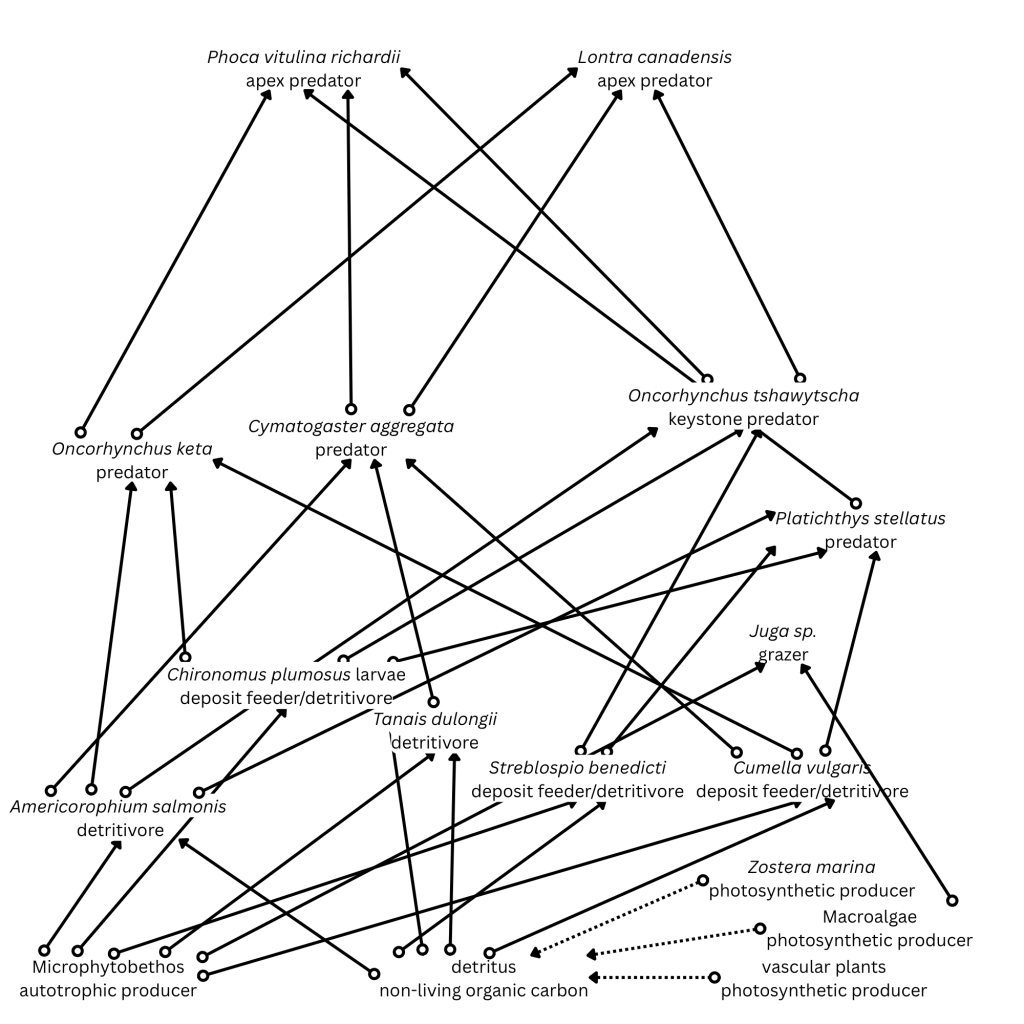
The review The rise of ecological parasitology: Twelve landmark advances that changed its history, shares 12 major advances in the field of parasitology, and while they are not exclusive to waterways, they are worth reviewing here in the background of the project. A few really stand out. In the first landmark, data displayed how evolution has naturally selected for host behavioral manipulation. (Poulin, 2021) This will be explored further in this essay. Landmark five reinforces the claims prior. There was a firm dismissal of the idea that parasites represent minuscule biomass, meaning to study parasites is to gain insight into ecosystem function, health and stability. (Poulin, 2021) Next, in landmark six, we learned that parasites can be accepted as agents of sexual selection driving co-evolution. (Poulin, 2021) This is especially critical when we consider marine habitats, where reproduction can include risks not experienced on land. The inverse is also true, land holds risks that water does not. This is a macro application of individual evolutionary traces.
Specific host phenotype and morphology matter to parasite infection. (Benesh et al., 2021) This concept will be further elaborated in later portions of the paper, but it requires statement here. As we consider this background from the definition of parasite and host, the establishment of ecological scale and specific ecosystem focus, we can understand how host choice matters much like mate choice. Across sources, the focus of globe-wide systems becomes clear in figure definitions. But first, we have to start with the parasites themselves.
case study I: a. simplex development and deployment
The focus of this section will primarily center around nematodes. Nematode is a phylum of roundworms, which are unsegmented and bilaterally symmetrical. They can be microscopic to several meters long. Understanding micro affects with macro applications, these worms fit naturally within this paper. They are one of the most numerous multicellular meiobenthic lifeforms on the planet (Klimpel & Palm, 2011), found in soil, fresh water, saltwater sediment, and extreme conditions where other lifeforms would falter and/or pass away.
Anisakis simplex is a species grouping including three sibling species, each with their own definitive genetics, life histories and geographical ranges. (Klimpel & Palm, 2011) As a group, each has a complex life cycle such that there is flexibility in host selection given local food web pressures and adaption. (Klimpel & Palm, 2011) After taking a sample of a series of marine organisms, to include pelagic invertebrates and vertebrates they found that while many animals can serve as intermediate hosts, the final host, cetaceans, was where reproduction took place. (Klimpel et al., 2004) The researchers found that prior to this definitive host, in the Norwegian Deep of the North Sea, larval stage three was discovered in P. norvegica, M. muelleri and P. verins.
The researchers also sampled two other potential hosts, C. finmarchicus and M. norvegica. Out of 1,722 C. finmarchicus and 4,780 M. norvegica, none had any form of Anisakis species. (Klimpel et al., 2004) This can serve as proof of an early concept on host specificity within parasites. Just because they can have fluid host selection does not negate that there is still evolutionary preference. The hypothesis is further affirmed when we consider host:parasiteprevalence. Within the sample, the data outlines P. norvegica having 0.26% with an intensity of one larva per infected host. Following this, we see a jump in M. muelleri at 49.6% in fish measuring at 6-7.2 cm long. (Klimpel et al. 2004) Here size mattered not only for fecundity, but also development. P. virens prevalence was a striking 100%, with a mean larva count at 193.6 averaged, ranging from 32-390 per host. (Klimpel et al. 2004)
There was data to support the massive jumps across species. M. muelleri occupies a low trophic level on the native food web. They can serve as prey for larger organisms (Thieltges et al., 2013), including P. virens. This paper concluded with a proposed life cycle hypothesis: A. simplex mature adults [in an assumed definitive host] release free-swimming L3 larvae. These floating larvae are consumed by the first intermediate host, P. norvegica. M. muelleri preys on the infected first host to become the second intermediate host. Within M. muelleri there is no further L3 development, but they remain infective. P. virens then feeds on the second host and becomes a paratenic host. The final development to a mature form occurs when this second host is consumed by a marine mammal such as P. Phocoena. (Klimpel et al., 2004) And thus, the hypothesis both closes, and begins the cycle again.
A summary could be stated as such: A. simplex in the Norwegian Deep demonstrates low host specificity. They climb the food web trophically via predator-prey relationships, and host factors. Thereby, they develop across a series of hosts based on current trophic level, the needed next level, ecosystem influence and local species distinction. This is important as we compare these nematodes to their global biomastic presence and their critical importance to modern food web models.
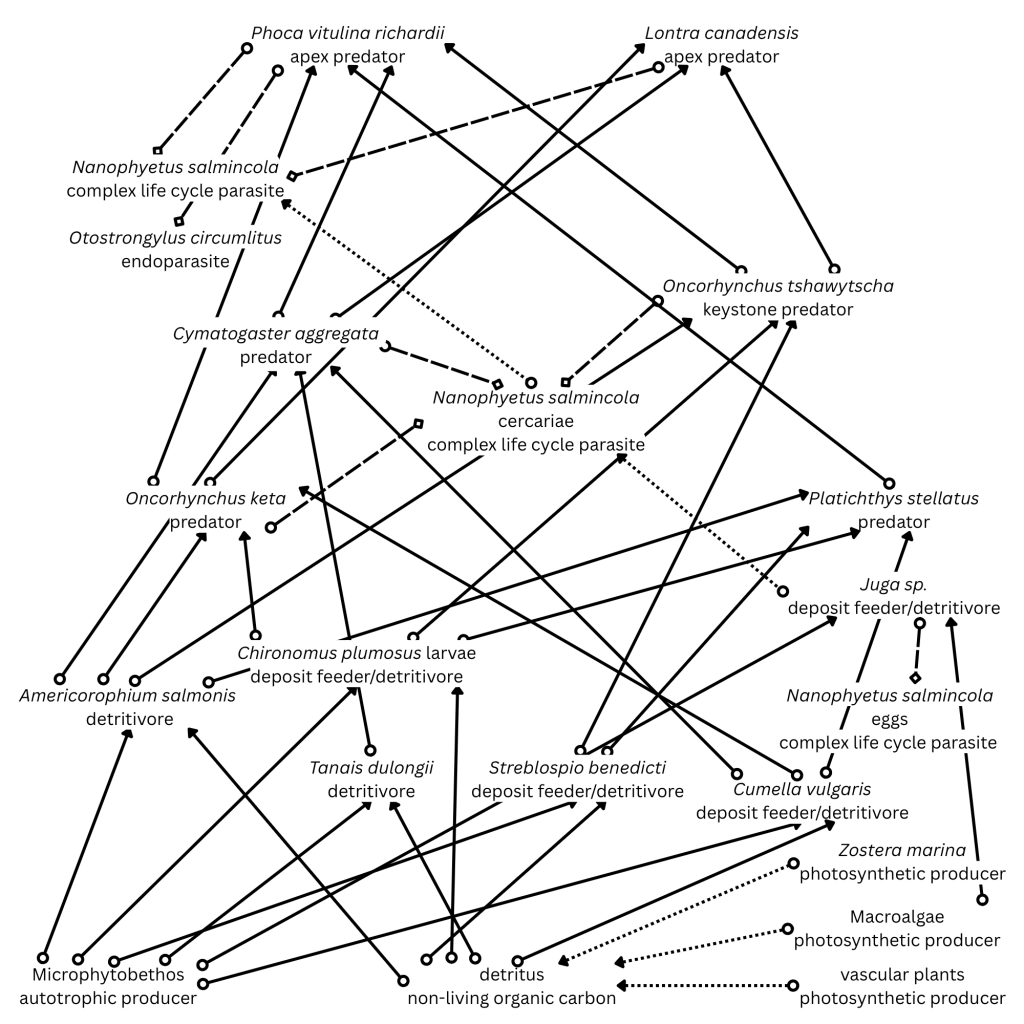
On the next page, we have a continuation of Figure I. This time two local parasites have been added to the existing Nisqually Delta food web. This concept is reaffirmed as the paper Parasites affect food web structure primarily through increased diversity and complexity notices. Parasites do not just represent biomass; they also represent significant portions of ecosystem biodiversity. Here, and in the next figure we see the introduction of concomitant links, where a predator consumes an infected prey item stowing the parasite, in this case N. salmincola, to further elucidate development and reproduction.
As the paper and this figure demonstrate, including parasites increased species richness and the total number of trophic links consistently. Link density is included as a factor here as well. While classic predation links generally outnumber classic parasite links, the connectance is abundantly altered. Two relatively small organisms, one with a complex life cycle, one direct to consumer, added together an additional 9 links, or an increase of 25.7% in total link count.
case study ii: behavioral manipulation and trophic transmission
Zooming out from parasite specificity, we can begin to focus on one of their most compelling core mechanisms, behavioral manipulation. Parasites can decrease host survival and reproduction, modify interspecies competition for resources and space, and alter predator-prey interactions all via manipulation of host behavior. (Mouritsen & Poulin, 2002) This paper focused on intertidal wetlands in New Zealand. Macro-invertebrates were the host type, and parasites included but were not limited to metazoan parasites, nematodes, isopods and larval cestodes. Behavioral manipulation increased exposure to abiotic factors like air exposure, osmotic stress and/or temperature shifts to list a few. Altered zonation was directly observed as a result of manipulation. (Mouritsen & Poulin, 2002)
Eggs alone were enough to alter host behavior. (Mouritsen & Poulin, 2002) To take this complex idea further we can see what the paper designated as impact on individual hosts. There was a direct stress from abiotic factors affecting synergistic survival. Reproduction was damaged because of increasing infection rates leading from partial to complete castration. Hosts, dependent on species, could experience either an acceleration or deceleration in growth. This was also influenced by nonparasitic impacts like resource availability and competition. Whether a side effect or an adaption of parasitism, the conclusion carries forth the idea is that this alteration is to facilitate trophic transmission leading to increased predation risk. They advise that the magnitude of impact is not constant. Spatiotemporal variability is a bias that must be acknowledged. (Mouritsen & Poulin, 2002)
As we hold these considerations, our attention should next be directed to ecosystem engineers. Going from a set deliverable to essay integration, the abundance of key host species—host density—can be a direct result of a two-part manipulation (Lafferty & Shaw, 2013); either activity level is increased or decreased. (Lafferty & Shaw, 2013) Altering microhabitats can have community-wide effects, leading to the if/then hypothesis stating that parasites can be indirect ecosystem engineers via physical abiotic factor changes. Such abiotic examples listed earlier should also account for sediment composition with altered behavior in intertidal macro-invertebrates. (Thomas et al., 1998)
There are two main classes of ecosystem alteration. Autogenic engineers transform the surroundings through their own physical structures, such as coral providing reefs. (Thomas et al., 1998) Allogenic engineers transform living or nonliving materials from one physical state to another, like a beaver and a dam. (Thomas et al., 1998) When a host is a significant part of the habitat, parasite:host alterations can have indirect effects. This is outlined directly in the paper Manipulation of host behavior by parasites: Ecosystem engineering in the intertidal zone?. A. stutchburyi, an intermediate host for C. australis, is native to and found along New Zealand’s coasts. The genus Haematopus is the definitive host of the parasite, and with the cockle’s foot being covered in cysts, sometimes up to thousands on one individual (Thomas et al., 1998), they could not bury or latch, thus laying as easy prey for the parasite’s host required to reproduce.
This alone is not enough to prove engineering. This is where the results of the field-test are important. Cockle’s shell serves as community space where anemones or limpets can plant. There was a negative relationship between the numbers of anemones and limpets found on cockle shells across all samples. (Thomas et al., 1998) Limpets are prey for anemones, so there are cross species interactions occurring within the structure provided by the cockle. While more limpets took space on manipulated hosts, and anemones were rarely found on those same hosts (Thomas et al., 1998), this is a prime case for the claim that trematodes like C. australis are allogenic engineers.
As we transition from host alteration to another core mechanism, trophic transmission, it will be important to keep all aspects of the essay together. Previously we’ve covered in figures two food webs. The first showed a traditional web without parasite biomass accounted for. This was a helpful framework for understanding the arguments put forward in the introduction and background, such that parasites are unrepresented, and critical nodes of a healthy, robust and functioning food web. In Figure II we observed the results of this directly, with the inclusion of an endoparasite and a parasite with a complex life cycle. Our work on synthesizing nematodes carried these concepts through and introduced a specific look at A. simplex. Most currently, we looked from what a parasite is, to what a parasite can do. While trophic transmission has been a key point in several arguments already made, it is appropriate to give it a dedicated space in the essay.
Let us begin with two simple laws governing food webs. The paper Dynamic basis of food web organization can be summarized according to its findings: The link-scaling law averages two links for every one trophic species and the hyperbolic connectance law holds that density connectance decrease rationally to increased species richness. (Cohen & Newman, 1988) While it is estimated that communities with thirty or more trophic species ecologists record less than or equal to 20% of dynamic interactions. At fifty species this statistic drops to 10% or fewer. (Cohen & Newman, 1988) This paper shows us directly why including parasites is not as easy as dropping them in the web. But it is also a stark call to begin working with parasites mathematically and empirically.
Let us briefly outline a potential reckoning with what parasites are doing in food webs before we consider how they move through them. In fresh water and marine food webs, biomass is calculated as wet weight (Kuris et al., 2008). There are multiple ways a parasite can be categorized, with this paper and my models focusing on life cycle strategies. Across three estuaries along the California coast, 138 infectious agents (including C. salina), 199 free living animal species and 15 vascular plants were modeled. From this the vascular plants formed the largest fraction of biomass in Bahia Falsa, Estero de Punta Banda and Carpinteria. (Kuris et al., 2008)
In their results, C. salina was measured at 0.27%. The range of biomass of free-living animals was 925 kg/hectare at Bahia Falsa to 2,600 kg/hectare at Carpinteria. (Kuris et al., 2008) Within this, parasites constituted around 0.2-1.2% of the total animal biomass. (Kuris et al., 2008) Parasitic castrators and trophically transmitted parasite stages were major contributors, reaching densities of 1-10 kg/hectare. When comparing free living hosts to infected host biomass, the larger animal that parasites depend on brought the biomass number up significantly ranging from 3.2-13.2%. (Kuris et al., 2008) This is a prime example put towards inclusion of micro organisms in a macro web. The picture is incomplete without them.
Within food webs, parasite transmission routes follow trophic relationships between successive hosts. (Poulin & Mouritsen, 2006) This would further argue that parasites are embedded in food webs and they influence both energy flow and structure. In the paper Climate change, parasitism and the structure of intertidal ecosystems, Company Bay, New Zealand’s habitat demonstrated parasites as a top trophic species, with acknowledgement that free living larvae can be consumed by predators. This paper concluded they do not just manipulate behavior or phenotype, but also energy flow. (Poulin & Mouritsen, 2006) They also clarified that parasites open new energy routes. (Poulin & Mouritsen, 2006) At this point it is clear that more complex stable systems include parasite interactions as key components of ecosystem stability.
There is still the issue of how to track and represent them properly according to energy flow. The paper Molecular ecology of parasites: Elucidating ecological and microevolutionary processes introduces new technology to the parasitology field, molecular markers. Using these as a tool, scientists can track transmission clearly, as well as host specific evolution and speciation. There is a bevy of possible applications using these tools, but the ones that stand out the most for this essay include identifying known species from morphologically indistinguishable life stages, elucidate parasite life cycles, and searching for cryptic species. (Criscione et al., 2005) PCR detection sequencing is a rapid way to screen potential hosts. They also can be applied at a more macro scale, where population genetic structure can reveal adaptation to local environments and hosts leading to speciation. This cause is significantly influenced by gene flow amongst populations and genetic drift within them. (Criscione et al., 2005) What is fascinating here is how migration and effective population sizes influence microevolutionary process.
case study iii: birds as hosts and vectors of parasite spread
This brings us to birds as hosts, often definitive at that. Within birds we are introduced to a new class of parasitic relationships, ectoparasites. These organisms, unlike all our prior types, live externally on their host. The tick, I. uriae will be the trace across species, biomes and ecosystems. They have a four-year life cycle spent mainly in the environment around the host. (McCoy et al., 2003) There is usually one multiday blood meal a year, triggering the next phase of development. (McCoy et al., 2003) Microsatellites allow tracking of gene flow within the parasitic population, while also helping us understand that despite the multispecies colonies of seabirds in the Northern Atlantic, tick infestation is not homogenous. (McCoy et al., 2003)
This introduces the concept of sympatric tick races. Even while living within the same bird colony, genetically distinct groups of ticks that specialize different host species maintain continuity. The paper offers this would suggest limited gene flow between host specific tick races (McCoy et al., 2003). This is fascinating as we have been tracking coevolution. The paper shows us how this plays out in overlapping puffin and kittiwake colonies. The population differentiation of the kittiwake ticks was almost twice that of puffin ticks. (McCoy et al., 2003) This demonstrates a clear pattern of isolation by nest distance; where kittiwakes had a more structured population compared to puffins, and less frequent gene flow, puffin populations were weakly structured even at large scales. This could be a possible indication that there is greater parasite dispersal and gene flow. (McCoy et al., 2003) This is why microsatellite tracking remains important. Across a thousand kilometers, the puffin’s ticks showed no significant genetic structuring between populations. (McCoy et al., 2003)
Tick genetic data offers a unique way to infer seabird movements and new colony establishment, even if these movements do not result in new breeding sites. (McCoy et al., 2003) Translocation as an act of ecological restoration will come back later in the paper, but here it breaks through first. Ectoparasites can be relocated at great distances by the movement of their host species. Frequent dispersal at large scales directly alters the tick’s population dynamics. This means that new breeding sites are easily colonized by the parasite, and the population can grow rapidly due to the influx of new eligible hosts. In a coevolutionary micro sense, the gene flow can introduce new alleles, potentially accelerating the tick’s adaption to local hosts. (McCoy et al., 2003)
Considering kittiwakes and I. uriae further, our next paper focuses on spatial colony structures, with gene flow influence carried as a throughline, while also reintroducing behavioral manipulation. A colony can consist of multifaceted nesting sites for a “larger colony”. The tick negatively impacts reproduction success and habitat selection. (McCoy et al., 2003) They are vectors of avian arboviruses and bacteria. (McCoy et al., 2003) They live in the nest microbiome. From here, the female feeds a final time, then lays hundreds of eggs, starting the life cycle again. They have a limited capacity for independent dispersal, and host difference in their genetic structure across life cycle stages. The paper notes that there are spatial variations in host susceptibility. (McCoy et al., 2003)
This brings us to R. tridactyla. These are long-lived seabirds’ nest by abiotic influence such as topologically and temporally on circumpolar cliff faces. They are pelagic and have high nest site fidelity. (McCoy et al., 2003) As one would expect of immune systems, there is variety in inherited ability to resist tick effects. Introducing one to another, the researchers found 173 ticks using aforementioned microsatellites to measure genetic diversity. (McCoy et al., 2003) They found ticks of all stages, with the exception of adult males, on kittiwake nestlings across the three sampled breeding cliffs. (McCoy et al., 2003) What is interesting and worth mentioning, adult male ticks do not feed, they only reproduce. (McCoy et al., 2003) The study revealed that ticks within all three cliff faces were varied but indeed genetically structured. (McCoy et al., 2003) While each cliff had different statistics, from the microsite of each nest to the macro of larger colony three cliff habitat, parasites were evolving as actively as the birds.
But what about the behavioral manipulation? This is where the paper Experimental evidence of high tick infestation limiting chick growth and survival in a colonial seabird comes through. While the behavioral influence is not as clear as x infects y and z is the result, one can garner further clarity when the whole scope of ecology is considered beyond the research’s framework. The paper explains this quite directly, cause and effect are difficult because the parasite might directly compromise a host’s condition or take advantage of a host weakened by other outstanding circumstances or factors. (Militao et al., 2024) Like the kittiwakes, black-browed albatross demonstrates site fidelity with long chick rearing periods. (Militao et al., 2024) This allows tick populations to build up substantially, with dependable nutrition resources.
The researchers randomly selected 28 chicks to be the tested via 14 days of tick treatment. They monitored tick-associated problems like blood loss, reduced body condition, growth rates and even higher mortality. (Militao et al., 2024) 49 control chicks were left to tick infestation. Higher tick load was associated with lower body mass, reduced growth rates, and poorer survival. (Militao et al., 2024) Here is the causal link outlined in the paper: treated chicks had significantly higher body mass at 14 days compared to the control group. (Militao et al., 2024) There was no difference in survival probability at 14 days, but this became clear at the fledgling age. The delay accrued as hypothesized that the sub-lethal effects take a toll over time. The data calculated that treated chicks had a 0.370 times lower risk of death compared to the control by the end of the fieldwork timeframe. (Militao et al., 2024)
Ecologically, reduced chick mass may intensify sibling competition for parental food. There is no greater behavioral manipulation than ending a life filled with behaviors. (This hypothesis requires direct behavioral evidence.) Unlike predation of larval stages discussed earlier, the ticks are no worse for wear so long as they fed enough energy from the chick. The pathogens transmitted by the ticks take several days to reach lethal stages. (Militao et al., 2024) If a chick dies, the parasite can wait for the migratory return the next year. I. uriae may be the first parasite to manipulate their host so extremely as to induce direct fatality without trophic transmission.
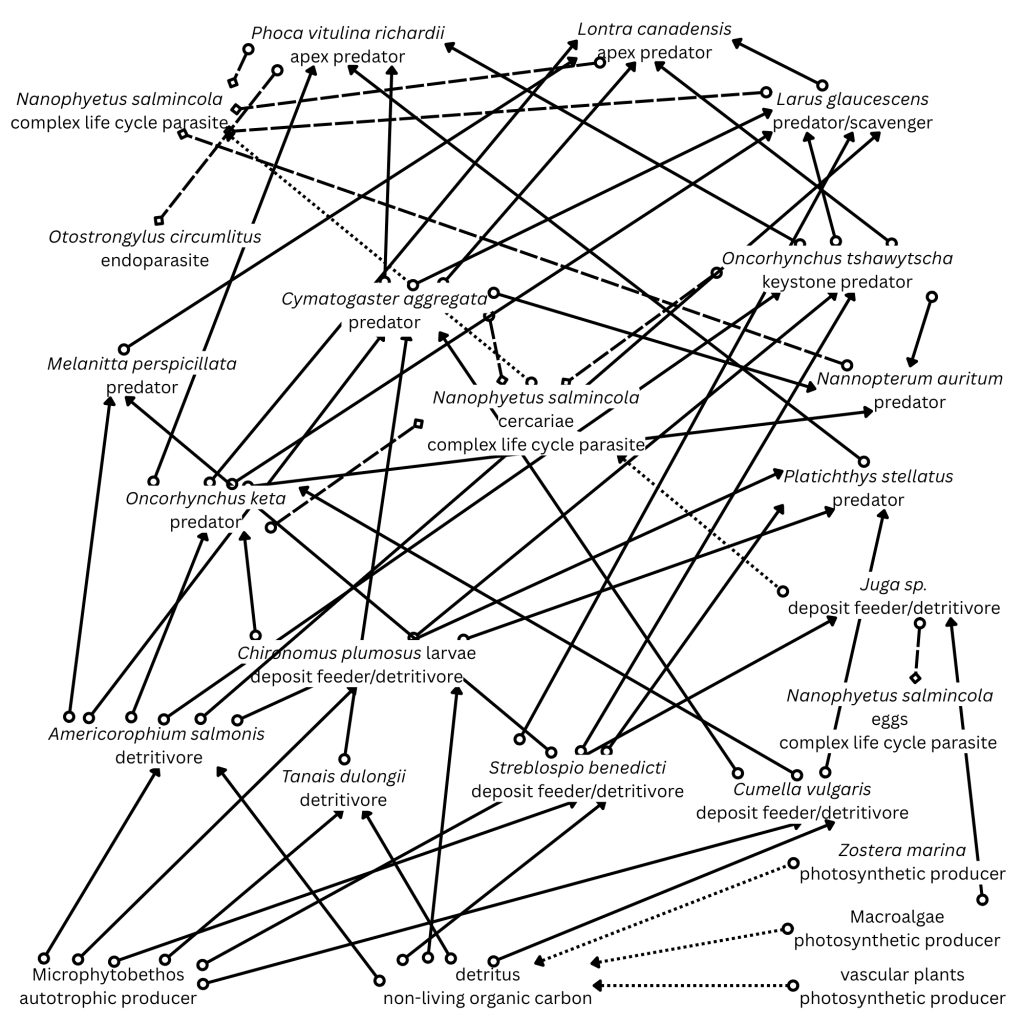
Allow us to now consider the hypothetical food web we’ve used throughout the paper. Here birds are not only apex predators, but also potentially definitive hosts. While N. salmincola is named after the fish it infects, birds, like the pre-standing mammals serve as critical nodes of the parasite’s life cycle.
Case Study III-IV: Birds and the climate
The carry-through from birds to climate overlaps significantly. Birds in coastal Connecticut and Florida had a parasitic range of C. spiculingerum from 5-183 worms. (Huizinga, 1966) Fish eat free living LS2 forms, serve as intermediate hosts, before being caught in lakes by the cormorants and pelicans. (Huizinga, 1966) Like Figure III, this shows that on a global scale, marine birds are critical aspects of consideration in parasitology; as are the webs they are a contributing to in a meaningful way.
Landlocking can occur from a slew of weather and temperature dynamics, as well as man-made obstacles—the only biotic factor of the potential. This is demonstrated in the paper Freshwater parasites as potential barriers to seabird dispersal: Evidence from vagrant booby specimens in western North America, where vagrancy events were tracked and studied in New Mexico and Colorado. Most helminths have complex life cycles. (Benesh et al., 2021) When sampling S. leucogaster in the recaptured birds, in New Mexico the birds had at least 9 and as many as 12 worms. (Baumann et al., 2023) Interestingly, the Colorado specimen had no endo- or ectoparasites. (Baumann et al., 2023) Here is a trophic reminder: Freshwater gastropods where the first intermediate host, fish preyed and became second. The birds, although not native still fulfilled a definitive host role, as the life cycles of these parasites is rarely host specific. (Baumann et al., 2023)
The novel susceptibility to new parasite species and taxa holds implications for evolutionary history and development (Baumann et al., 2023) as more seabirds are brought inland by the changing climate. There is man-made intervention that occurs to address this issue. This issue, when including climate developments is so complex multiple sources will be cited together, rather than the earlier pattern of one paper at a time.
Case Study IV: Climate’s abiotic drivers
From Dunlop and Watson (2022), we learn that translocations as ecological restoration is a path taken with high cost. The purpose is not limited to expanding the population of endangered species to investing genetic diversity in isolated groupings. (Dunlop & Watson, 2022) The biggest risks are both related to disease. First, the transmission of diseases already present in the source population or secondly, novel disease exposure in the new environment. (Dunlop & Watson, 2022) Now that we understand the managed stakes, let us look directly at this from a species level. Decline and extinction in host populations threatens species-specific parasites (Dunlop & Watson, 2022) which other papers have echoed as bellwether organisms. The paper keeps walking us through all the ways this concept is poorly executed. Not in lack of trying, but the complexity of all that must be considered.
This brings us to the enemy release hypothesis, or as suggested, where invasive species succeed because they leave behind their natural enemies, to include parasites. (Chalkowski et al., 2018) The co-argument, or the spillover hypothesis, is where a parasite endemic to one species infects a new host (Chalkowski et al., 2018), much like the pelicans, boobies, and cormorants across the continental US. There is an inverse to this prior hypothesis, the spillback theory. This is when an invasive or vagrant host is infected by a native parasite, thereby accelerating infection for native host species. (Chalkowski et al., 2018) Here we have our first paper cross over to Climate change, parasitism and the structure of intertidal ecosystems. The authors summarize that recent studies have firmly linked alterations and ecosystem property fluctuations, including wide-scale weather change, to indicate temperature is an abiotic driver. (Poulin & Mouritsen, 2006)
This paper must be presented independently. Where land and sea meet, this is often where the most severe direct results are recorded. Along Otago Harbour in New Zealand, the study reveals plainly what others have too: Parasites are not just biological passengers. They can regulate host population abundance, influence the compositional structure of animal communities and even affect, as has been demonstrated, how ecosystems function across scales from organismal scale to ecosystem reach. (Poulin & Mouritsen, 2006)
In humans and otherwise, recent reports have highlighted a causal relationship between climate change and emerging parasite diseases. (Pufall, 2010) Globally these are defined as sudden increase and prevalence [biotically] or geographical spread [abiotically]. (Poulin & Mouritsen, 2006) To keep a tune on geology, the paper shows direct results from trematodes in cockles, a familiar haunt. It bears rewording, the reduction of mobility leads to reduce bioturbation of settlements. The result? The surface becomes more heterogeneous (Thomas et al. 1998), a biotic outcome that holds abiotic implications.
As the climate continues to change, host ranges and ecologies will shift, holding sway over their parasite dynamics. Mining, pollution and chemical contamination are among the harshest human pressures worsening marine ecosystem degradation. This ever-changing development has reached levels of ecological devastation so severe it has been termed a mass extinction event. As this paper has shown, across biomes and ecosystems, parasites are an indicator of environmental health (Miljutina et al., 2010). The ocean is one such ecosystem undergoing significant degradation and exploitation.
Our studies will end on a very human note. For many parasites, to include fleas, humans are a dead-end host. (Pufall, 2010) This is not a claim of totality, which would be absurd, but instead a grounding fact. In Nunavik and Nunatsiavut, the Inuit people have a direct cross-scale relationship with their food. The thesis Engaging northern communities in monitoring traditional country foods for zoonotic anisakis nematodes summarizes it as a direct relationship to nutrition, emotion, social, and spiritual wellbeing. The fish are smoked, fermented, or eaten raw. (Pufall, 2010) Naturally, without cooking, the threat of parasites and other organisms does not get neutralized by heat. A. simplex returns. Both A. simplexand P. decipiens cause anisakidosis. (Pufall, 2010)
Despite this, country food is a vital link to both land and heritage. Those who took part in the interconnected research expressed a concern at the loss of their history. (Pufall, 2010) “Key themes that emerged from all communities [sampled] was a desire for participatory research[.]” (Pufall, 2010, p. 27) We have to hear this claim humbly. When they were asked to consider the presentation and dissemination of data, they offered back ideas and boundaries, such as English and Inuktitut presentations (Pufall, 2010). Across all of this is warming, sea ice melting, pollution, mining and chemical contamination are affecting food sources. (Pufall, 2010) As the climate changes, and food sources shift, cultural presentation and preservation of scientific findings and research data matters to those receiving it as much as those presenting it.
conclusion
And so, we are back where we started, considering the direct impact of parasitism at a host:parasite scale. After the background for how, what, and why parasites that also included the where, we had enough to consider a more “traditional” model of a local ecosystem in the Pacific Northwest. There were trophic levels with multiple organic inputs beyond explicitly animals. This already began expanding the picture, before we zeroed in on nematodes generally and A. simplex directly. Here, at the conclusion we see this parasite as one of ours. Once two local parasites were added to the Nisqually Delta web, the paper delivered on its claims.
The next set of case studies brought in birds, as transmitters, hosts and top of the food chain impact. Still, they were subjected to parasites. Endo- and ectoparasites both, acting so consequentially as to increase chick mortality in the black-browed albatrosses. Like parasites birds are also indicator species of global and ecosystemic wellness. Once they were included in the modelled web, the links exploded, often including the complex life cycle parasite N. salmincola. As a developer, it was very exciting to see, including the fact of potential empirical testing that can later be applied as the skills develop.
Finally, we were able to address one of the critical issues facing our planet. The climate change driving the 6th mass extinction on Earth. To make all of this micro and macro application realistic, it was important to end with us, and how we learn, respond and carry forth. Knowledge for the sake of knowing serves no one. Over this paper, 35+ sources have been reviewed and three figures conceptualized. What matters is not that this information is synthesized, but that like the parasites it follows, it is transmissible. In prior courses, art has been studied across media and medium to serve as an intricate role in community awareness. My development as a researcher in academia has demonstrated how intersectionality develops. Within the appendix, I have shared a poem inspired by this essay to offer just how much left we must learn. This does not rewrite the research. It transitions into a place of person:person reception.
Interdisciplinary Appendix: fecundancy
“starting conspicuously smaller
needing a larger host to get evolution going [sex]
proportional to body size
usually
access for more offspring
helminths, all of you!
links between
predator
prey
all why
a complex life
could occur,
naturally of course
trophic jumps
hip hoppity skip
there goes the nematode
draining the whole way
endothermic definitive
made it here xe did;
a bird or a mammal;
warm enough to fuck—
disproportionately so.
growing more and faster
larger is better this time [x how many millions
of mating pairs]
energy rich
thermally optimal
not growing at rates faster,
per say
rather later maturation
after a few hosts, you know
establishment success
achieved
downward incorporation
activated
—
fecundity finished
inside of others.”
References and Annotated Bibliography (available in document)

